



This week we are going to one of the most interesting geologic places in the world, and for me, a blast from the archives of my first “Little Yellow Book” from 2008.
I was an undergraduate at The College of Wooster when I went to Iceland to conduct fieldwork that would become my Senior Independent Study Thesis
For many of us geologists, field work is a huge reason we fell in love with the science. This trip had a profound impact on my career as a geologist. I learned how to conduct field work, take samples, analyze them using various lab tools, synthesize information, and ultimately write a thesis that I still use as an example today. So let’s go check out some “hot-spots” (geology pun very much intended) on the island of Iceland!
Iceland is LOADED with unique geologic features to see, including volcanoes, glaciers, columnar joints, and waterfalls. If you visit, I would encourage you to do additional research for things to see and do, especially within the major cities of Reykjavík and Keflavík, as we will just scratch the surface here.
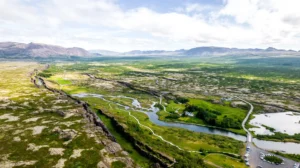
Area geology: Iceland is geologically unique due to being situated along the slow-spreading Mid-Atlantic Ridge, where the North American and Eurasian plates diverge, while also interacting with the Iceland plume that is currently situated in the southeast region of the country.
- Iceland is the only place where you can see the Mid-Atlantic Ridge exposed on land.
- A visit to Þingvellir National Park is essential to see two tectonic plates at the same time.
- This is also the original home of the Icelandic government, so you can pack in some recent history along with nerding out on the geology.
- The geothermal springs and volcanism in Iceland are also renowned.
- Iceland is home to roughly 130 volcanoes across 32 active systems.
- If you stop at Blue Lagoon, perhaps the most famous geothermal area, make sure to try some of their skincare products, made using the site’s geothermal seawater.
The most common way to see Iceland is along historic Route 1, also known as the ring road.Plan your visit:
- Starting from Akureyri, you can drive this with a normal rental car and choose to stay in hotels/hostels or camp along the roadside in designated spots. The road loops around the entire island.
- Be advised that if you want to go further inland to the interior, you will need four-wheel drive.
Here are some of the must-see spots along any Ring Road drive. I’ve placed them in the order in which you would encounter them.
-
-
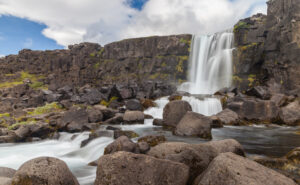
- Goðafoss: Waterfall showing fanning columnar joints just off the highway
- Krafla: Active volcano in a very geothermally active area with young lava flows (less than 50 years old)
- Hverir: A naturally hot spring near Krafla. My notes state “looks like Mars, literally!”
- Dimmuborgir: Lava flowed into a topographic low, then the lake collapsed forming unique formations.
- Dettifoss: The most powerful waterfall in all of Europe with spectacular columnar joints.
- The eastern side of Tjörnes Peninsula: Excellent spot to see Puffins, and some neat igneous rocks
- Húsavik: Great town where you can head to the beach and see a transform fault running through town
- Jökulsárlón, Fjallsjökull, Háalda, Svinafellsjökull: Glacial lagoons near route one
- Skaftafellsjökull: Check out the visitor center and learn about how the bent I-Beams ended up on the beach
- Skógafoss and Gullfoss: More waterfalls not to be missed

- Geothermal pools: End your trip at one of the island’s geothermal pools. Blue Lagoon is the most touristy, but others in the area are great as well.
Go deeper: Read more about the geology of Iceland here.
First published :
Sloan, J. A. (2026, February 5). GeoTourist Heaven: Iceland. GeoLifestyle (Edition 95). American Association of Petroleum Geologists.
Retrieved from https://newsletters.aapg.org/geolifestyle-02-04-26
-